
Calculus 2, part 2 of 2: Sequences and series

A total of 60 hours of lectures

This is an academic level course for university and college engineering. Due to its size, it is divided into two parts. This page describes the second of those two parts.
Level - Intermediate

You need to be familiar with the contents of the four Precalculus courses and Calculus 1, part 1 and 2, and Calculus 2, part 1, to comfortably follow along in this course.

Curriculum

Make sure that you check with your professor what parts of the course you will need for your exam. Such things vary from country to country, from university to university, and they can even vary from year to year at the same university.

Calculus 2, part 2 of 2

h

Get the outline

A detailed list of all the lectures in part 2 of the course, including which theorems will be discussed and which problems will be solved. If you are looking for a particular kind of problem or a particular concept, this is where you should look first.

Get Calculus 2 part 2 on Udemy

When you buy the course on Udemy, you get access to it for life. There is just a one-time fee. The prices do vary a lot on Udemy, but if you use our link by clicking on this panel, you will get the best current price. See also our page on “coupon codes” in the menu (the current code is TPOT_OCT26).

Course Objectives & Outcomes for part 2

Z

How to solve problems concerning sequences and series (illustrated with 378 solved problems) and why these methods work.

Z

Limits of number sequences, both finite and infinite (repetition and continuation of the topic introduced in Calc1p1).

Z

Dealing with indeterminate forms (repetition and continuation of the topic introduced in Calc1p1).

Z

Squeeze Theorem for sequences (repetition and continuation of the topic introduced in Calc1p1).

Z

Functions defined for all positive arguments and their role in examining number sequences (monotonicity, limits).

Z

Stolz-Cesàro Theorem for computing limits of indeterminate forms.

Z

Cauchy Theorem (convergence of the arithmetic means of a convergent sequence).

Z

Examining the differences of consecutive terms of the sequence (a_n) for determining convergence of a_n/n.

Z

Some applications of sequences (discretisation, approximations); sequences in other courses.

Z

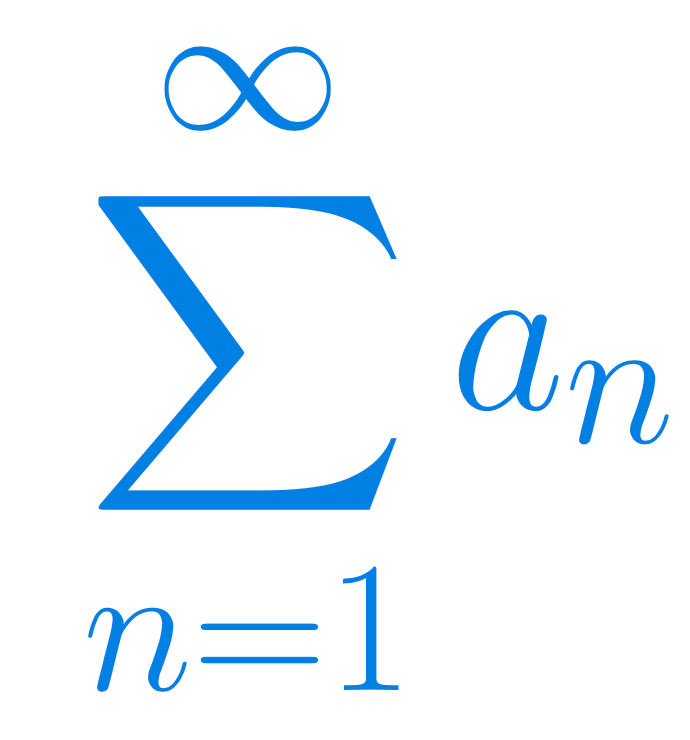
Series as limits of partial sums of sequences: definition and examples.

Z

Arithmetic and geometric series and their convergence.

Z

Comparison criteria for series.

Z

Ratio test for series.

Z

Sequences of real-valued functions (a very brief introduction).

Z

Power series and their radius of convergence.

Z

Applications of Taylor polynomials for approximating values of functions.

Z

Sneak peek into the content of the next course (Real Analysis: metric spaces).

Z

Various ways of defining number sequences: with help of a descriptive definition, an explicit (closed) formula, a recursive definition.

Z

Arithmetic on extended reals (repetition and continuation of the topic introduced in Calculus 1 part 1).

Z

Standard limits, comparing infinities (repetition and continuation of the topic introduced in Calc1p1).

Z

Weierstrass' Theorem for sequences (repetition and continuation of the topic introduced in Calc1p1).

Z

Solving recurrence relations: closed formula for linear recurrences of order two (with or without initial conditions).

Z

Ratio test for sequences for determining convergence or divergence.

Z

AM-GM inequality; convergence of the geometric means of a convergent sequence.

Z

Examining the quotients of consecutive terms of the sequence (a_n) for determining convergence of the n-th roots of a_n.

Z

Cauchy sequences and completeness of the set of real numbers; Bolzano-Weirestrass' Theorem.

Z

Convergent and divergent series: simple and advanced examples.

Z

p-series, their relation to p-integrals; discussion of their convergence.

Z

Integral test for series.

Z

Root test for series.

Z

Series of real-valued functions (a very brief introduction).

Z

Taylor polynomials and Taylor series, smooth functions.

Z

Applications of Taylor polynomials for computing limits of indeterminate forms.

Francisco O.
Udemy student
It was another amazing course very deep. But with many exercises cover along the road. Other point, that i liked it a lot is the interplay between theory and practice. For example it may be difficult to grasp the divergence between all the types of convergences of series if only looked by theory but with the help of the many examples it becomes clearer. That it is true that math is hard, by many reasons one of them is a time consuming activity but with Hania methods of teaching and experience is less difficult.
Vasanth G.
Udemy student
Repetition of the concepts again and again is helping a beginner like me, thank you
Hassan K.
Udemy student
Always an amazing course as I expect, thanks a lot to Hania and Martin!
Frederick S.
Udemy student
Superb course!
Andrzej P.
Udemy student
A phenomenal addition to the calculus 2 series. The course is very well structured, with clear and well planned out lectures. The course also contains many videos dedicated to solving exercises, designed to help the student understand key concepts and techniques.